
Ethiopia Export: a custom B2B commodity catalogue for Hajuta Trading
From a corporate website to a buyer-first export catalogue
Hajuta Trading exports Ethiopian spices, coffee, oilseeds and pulses from Addis Ababa. We built ethiopiaexport.net on WordPress as a buyer-first export catalogue with no cart and no public prices, four custom plugins, a SKU-based importer and a crop calendar tied to every product.
Live on the client's own server since September 2026.
Titan Digital Marketing built ethiopiaexport.net for Hajuta Trading, an Addis Ababa exporter of Ethiopian spices, coffee, oilseeds and pulses. The site turns WooCommerce into a B2B export catalogue with no cart or public prices, a custom child theme, four custom plugins, a SKU-based CSV importer and a crop calendar linked to every product.
The Ethiopia Export case study shows how Titan Digital Marketing built a B2B commodity catalogue for Hajuta Trading, an Ethiopian exporter trading since 2000. In short: we kept WordPress and WooCommerce for what they do well, product records, categories and URLs, and wrote our own code for everything an export buyer needs and a retail store lacks.
Where we picked it up
Hajuta Trading already ran a corporate website at hajuta.com. What it lacked was a place where an importer could study the product range, check specifications and ask for a quote without a round of emails first.
Export buyers want the same facts before they open a conversation: grade, moisture, packaging, minimum order quantity, HS code (the Harmonized System code that customs authorities use to classify traded goods, maintained by the World Customs Organization) and when the next crop ships. A corporate website tells a buyer who the company is. It does not answer those questions product by product.
Hajuta Trading wanted a dedicated export site, ethiopiaexport.net, running as a sister site to the corporate one, on its own server, with a catalogue its team could keep current without a developer.
Why a normal online store was the wrong tool
WooCommerce out of the box assumes a shopper with a card, a price and a cart. A commodity importer buying containers by the season behaves nothing like that.
Price, cart, checkout
Standard WooCommerce fields cover price, stock and shipping weight. The default CSV importer maps those retail fields. Neither has a place for purity, moisture, Incoterms or harvest windows.
Specs, terms, timing, then a quote
An importer checks grade, packaging, minimum order quantity, HS code and shipment window first. Prices depend on volume, crop and Incoterms, so a public price would be wrong for most buyers the day it went live.
An export catalogue that looks like a shop loses the serious buyer
Our read: in commodity trade, a visible price and an "Add to cart" button signal a retail seller. A professional importer reads that as a small reseller and moves on. The same importer stays when the page answers the questions a procurement team asks before it picks up the phone.
That is why the brief on this project was subtraction as much as construction. We removed the cart, the checkout and the price layer, then filled the space with the facts a buyer's procurement checklist asks for.
What we built
Every layer above the WordPress core came from our team: the child theme, four plugins, the importer and the crop calendar. We kept catalogue logic out of the theme so the client can change the design without breaking the data.
Hajuta child theme on Kadence
A child theme (a theme that inherits a parent theme and overrides only what it needs) built on Kadence. It controls product and category layouts, specification panels, catalogue cards, the crop calendar and the sample-request flow.
Structured export fields and a SKU importer
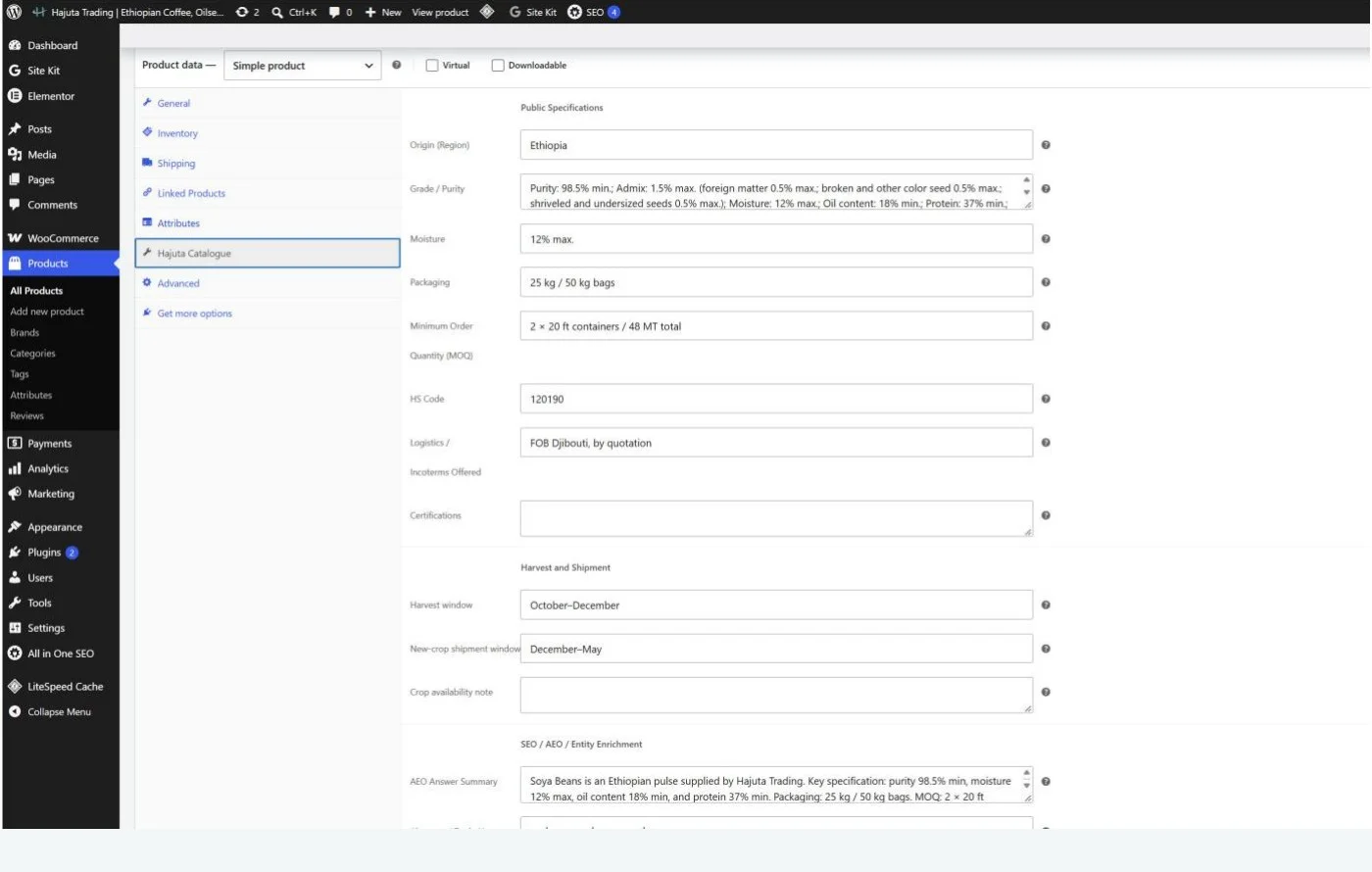
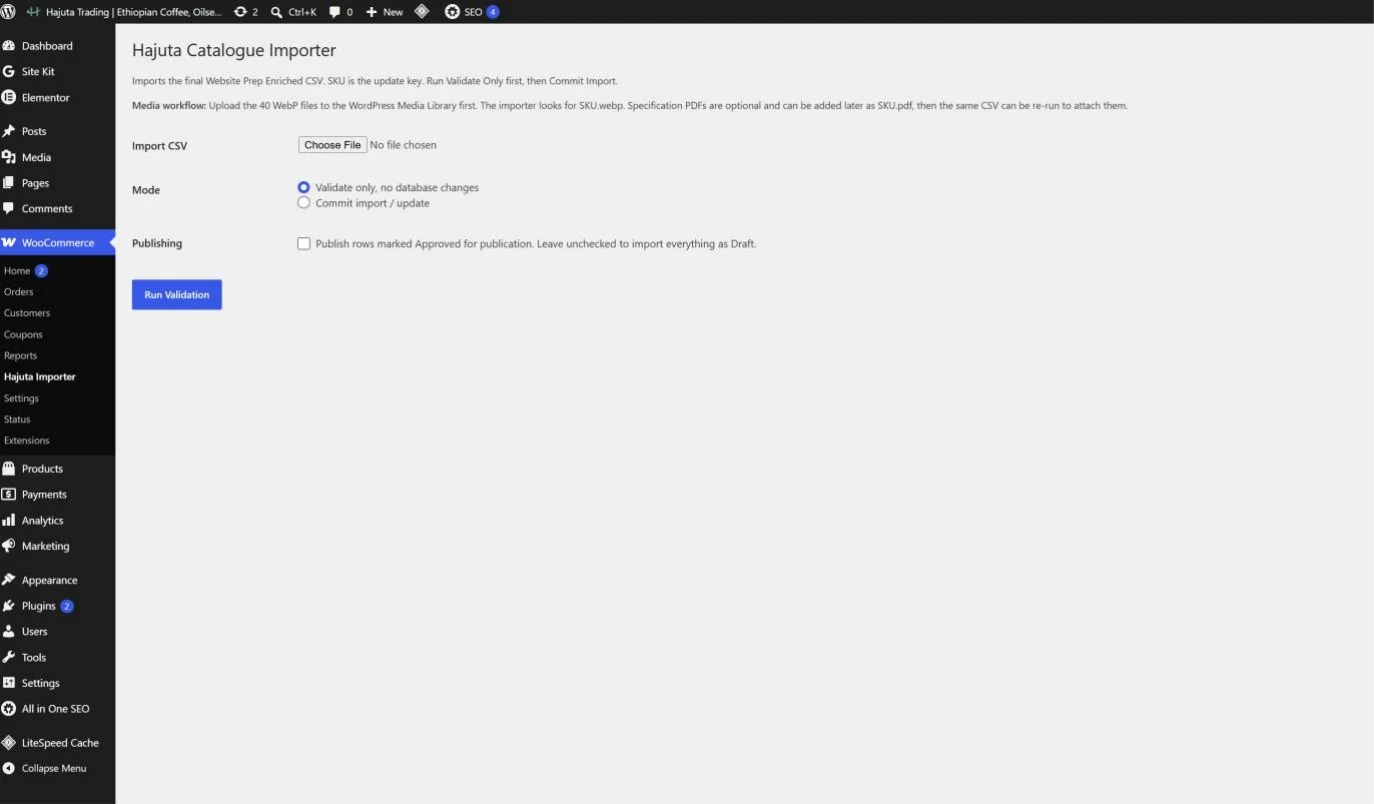
Adds dedicated fields for origin, grade and purity, moisture, packaging, MOQ, HS code, Incoterms, certifications, harvest window and new-crop shipment window. Its CSV importer validates a file first, then creates or updates every product by SKU.
A quote form tied to the exact product
Replaces the cart with a B2B quotation form. Each request carries the product's SKU, so the sales team knows exactly which commodity and specification the buyer looked at.
Reliable delivery and clean search data
Hajuta Mailer sends every inquiry through authenticated SMTP so quotes reach the inbox, not the spam folder. Hajuta SEO adds the company's organisation details to the existing schema without creating duplicates.
How the catalogue speaks to Google and AI search
A buyer in Rotterdam or Dubai now asks ChatGPT, Gemini or Google AI Mode where to source Ethiopian sesame or soya beans. The catalogue had to give those systems facts they could quote.
Each product carries an AEO Answer Summary: a short, factual paragraph near the top of the page that names the product, its origin, its key specification and its packaging. AEO (Answer Engine Optimization) means writing content so answer engines can lift a complete, accurate statement from it. We explain how AEO fits with SEO and GEO in our visibility pyramid guide.
The structured data on every product comes from the same SKU record as the visible text. Google's product structured data guidelines require markup to match what the page shows, so we never publish prices, stock levels or offers that the page does not state. Search engines and AI tools read verified product facts and nothing invented.
| Layer | What it does for buyers | What it does for search |
|---|---|---|
| Spec fields | Answers procurement questions before contact | Supplies clean, consistent product facts |
| AEO Answer Summary | Gives a one-paragraph product overview | Gives AI tools a quotable statement |
| Crop calendar | Shows harvest and shipment timing | Links seasonal pages back to product records |
| Category pages | Groups spices, coffee, oilseeds and pulses | Adds original commodity context to each archive |
Where we ended up
Hajuta Trading launched ethiopiaexport.net on its own server in September 2026, about one month after the project started.
The catalogue updates from one spreadsheet
The sales team prepares one CSV, runs a validation pass and commits it. New products, new specifications and new crop dates go live without editing pages one by one.
Buyers arrive pre-qualified
Grade, moisture, packaging, MOQ, HS code, Incoterms and shipment windows sit on every product page, so a buyer has the answers to the usual procurement questions before first contact.
Every quote names its product
Each quotation request arrives tied to an exact SKU, so the team replies with the right specification and the right shipment window on the first message.
The client owns everything
The site runs on Hajuta Trading's server, and the company holds owner access to Google Search Console and Google Analytics 4. We handed over a full architecture and administration record at launch.
Building something similar? Our e-commerce website design service covers catalogue and B2B builds, and our SEO, GEO and AEO service covers the search layer after launch.
Questions about this project
Can WooCommerce run a B2B catalogue without a cart or public prices?
Yes. On ethiopiaexport.net, Titan Digital Marketing uses WooCommerce only as the catalogue engine: product records, categories, images, SKUs and archive pages. A custom child theme removes the cart, checkout and price display, and a custom quote plugin replaces the purchase step with a quotation request tied to the product's SKU.
What product information do commodity export buyers need online?
Commodity buyers check specifications before they ask for a price. For Hajuta Trading, each product page shows origin, grade and purity, moisture, packaging, minimum order quantity, HS code, Incoterms, harvest window and new-crop shipment window. Showing these facts up front filters out buyers who cannot meet the terms.
How does a crop calendar help an agricultural export website?
A crop calendar shows when each commodity comes into season and when new-crop shipments can leave. On ethiopiaexport.net, the calendar links back to each product record, so a buyer planning a purchase sees timing and specifications together and can request a quote for the right shipment window.
How long did the Ethiopia Export build take?
Titan Digital Marketing built the Ethiopia Export platform for Hajuta Trading in about one month, including the child theme, four custom plugins, the CSV catalogue importer and the crop calendar. The site went live on the client's own server in September 2026, and Hajuta Trading owns the platform and its analytics.
Need a catalogue that sells like a trader?
Tell us what your buyers ask before they order. We will show you how a custom B2B website can answer it for them.

Kaan leads strategy at Titan Digital Marketing, an agency he has run since 2008 across Canada, the USA, Hong Kong, and the UAE. He oversees Titan's custom WordPress and WooCommerce builds for exporters, logistics firms and B2B suppliers across the UAE and Africa. He teaches AI strategy at Istanbul Finance Institute and runs regular AI and marketing workshops at Innovation City, Ras Al Khaimah.