
AI and Human Creative Collaboration in Marketing Does Not Replace Your Brain. It Amplifies It.
Every week, thousands of AI-generated campaigns flood social media with the same structure, the same urgency, and the same predictable angles. This is not an AI problem. It is a workflow problem. Here is the framework that fixes it.
AI and human creative collaboration in marketing works by assigning the right job to the right entity. The human brain makes the lateral, non-obvious connection between a product and a cultural artifact. The AI maps the structural parallels and builds out the campaign architecture. Neither step works without the other. This is the only workflow that consistently produces original campaigns at scale.
Why AI Produces the Same Campaign Over and Over
Understanding the bell-curve problem is the first step toward building something that breaks out of it.
AI language models are probability engines. They are trained on vast datasets of human-produced text, and their function is to generate the most statistically likely response to any given input. When a marketer feeds a brief into an AI model and asks for a campaign, the model searches its training data for the most common, most expected answer. What emerges is a reflection of every other campaign ever written on that subject.
This is the bell-curve problem. The model delivers what lives at the center of the statistical distribution, which is precisely the content that every other practitioner is also producing. The result is what one experienced marketer described precisely: a sea of posts where the narrator changes, the brand changes, and sometimes the industry changes, but the underlying message is structurally identical. Like a shirt. Different people, different sizes, different colors. Same shirt.
This is not a failure of the technology. It is a failure of the workflow. AI was not designed to be an imagination replacement. It was designed to be a processing engine. Research by the McKinsey Global Institute on generative AI confirms that the highest-value creative applications pair human judgment with AI execution rather than replacing one with the other. The moment practitioners began using it as the primary idea generator, they handed over the one element that makes a campaign cut through: the illogical, lateral, human spark that no model can produce from first principles.
Standout marketing requires finding the statistically unlikely connection that still makes perfect emotional or logical sense. A model researching a topic will rarely connect a digital strategy problem to the pacing of a jazz solo. Those domains do not naturally overlap in its training weights, but they overlap perfectly in a lived human experience.
What Does Templated Content Actually Look Like?
The pattern is consistent across platforms. A business posts about productivity using a morning routine metaphor. A competitor posts about productivity using a sports training metaphor. A third posts using a military metaphor. The metaphors rotate but the emotional architecture underneath is identical: discipline leads to results, consistency beats talent, small daily actions compound over time.
All three posts are technically correct. All three are competently written. None of them will be remembered by Friday. Because none of them required a human imagination to produce. Any model with access to the same training data would have generated the same frameworks given the same prompt.
The antidote is not better prompting. It is a structured workflow that forces the human brain to make an imaginative leap before the AI is ever introduced to the brief. That is the foundation of the Open Highway Framework described in the next section.
4 Steps to AI and Human Creative Collaboration That Produces Original Campaigns
Each step is assigned to the right entity. Steps 1 and 2 belong to the human. Steps 3 and 4 begin with the AI and finish with the human. The sequence cannot be reversed without breaking the outcome.
Select a product or service. The more technical or traditionally dry the subject, the better. A rigid, unglamorous subject forces genuine creative thinking and prevents the exercise from defaulting to obvious angles. The product is the anchor that keeps the campaign grounded in reality.
Step away from every AI tool and find an organic cultural artifact: a specific film scene, a song, a piece of personal nostalgia, a historical event, a news headline, or a magazine cover. This step must be completed without automated assistance. The constraint forces the human brain to do the divergent, non-linear thinking that no model can replicate.
Feed both the product anchor and the cultural artifact into the AI simultaneously. The prompt must instruct the model to map the logical and emotional parallels between the two domains and construct a structured marketing angle from those intersections. The AI operates here as a pure pattern-recognition engine, not as an idea generator.
Review the AI output and remove the obvious connective tissue. Strip 20 to 30 percent of the explanatory text. Just as the spaces between notes in a jazz solo carry as much meaning as the notes themselves, intentional gaps force the audience to participate in completing the narrative. That interaction is what makes the campaign memorable.
The critical design principle behind this sequence is that it assigns the right cognitive task to the right entity. The human provides what AI cannot: the initial abstract, illogical leap between two unrelated domains. The AI provides what humans cannot match for speed: the ability to process both inputs and surface every possible structural and emotional parallel between them in seconds. Neither works without the other.
This is not a theoretical framework. It was tested as a live exercise, and the results documented below show exactly what happens when the sequence is followed correctly, and what happens when it is corrected mid-execution by the human reviewer.
From a Generic Flyer to a Campaign With a Soul: Before, First Attempt, and Final Result
The following three images document a real-time execution of the framework. The anchor was a local gym. The lateral jump was a specific classic rock anthem. The images show exactly how the process unfolds, and how human correction sharpens the output at each stage.

The Anchor and the Lateral Jump
The product anchor was a fitness club serving residents of Ras Al Khaimah. The lateral jump was a classic rock anthem known for its themes of urgency, ownership, and the open highway as a metaphor for personal freedom. These two domains have no obvious overlap. A gym and a song from a completely different era and genre do not naturally intersect in any AI training dataset. That non-intersection is precisely what makes the exercise work.
Both inputs were fed to the AI with a single instruction: map every logical and emotional parallel between the song's themes and the core proposition of the fitness club. Find the intersections and build a campaign from them.
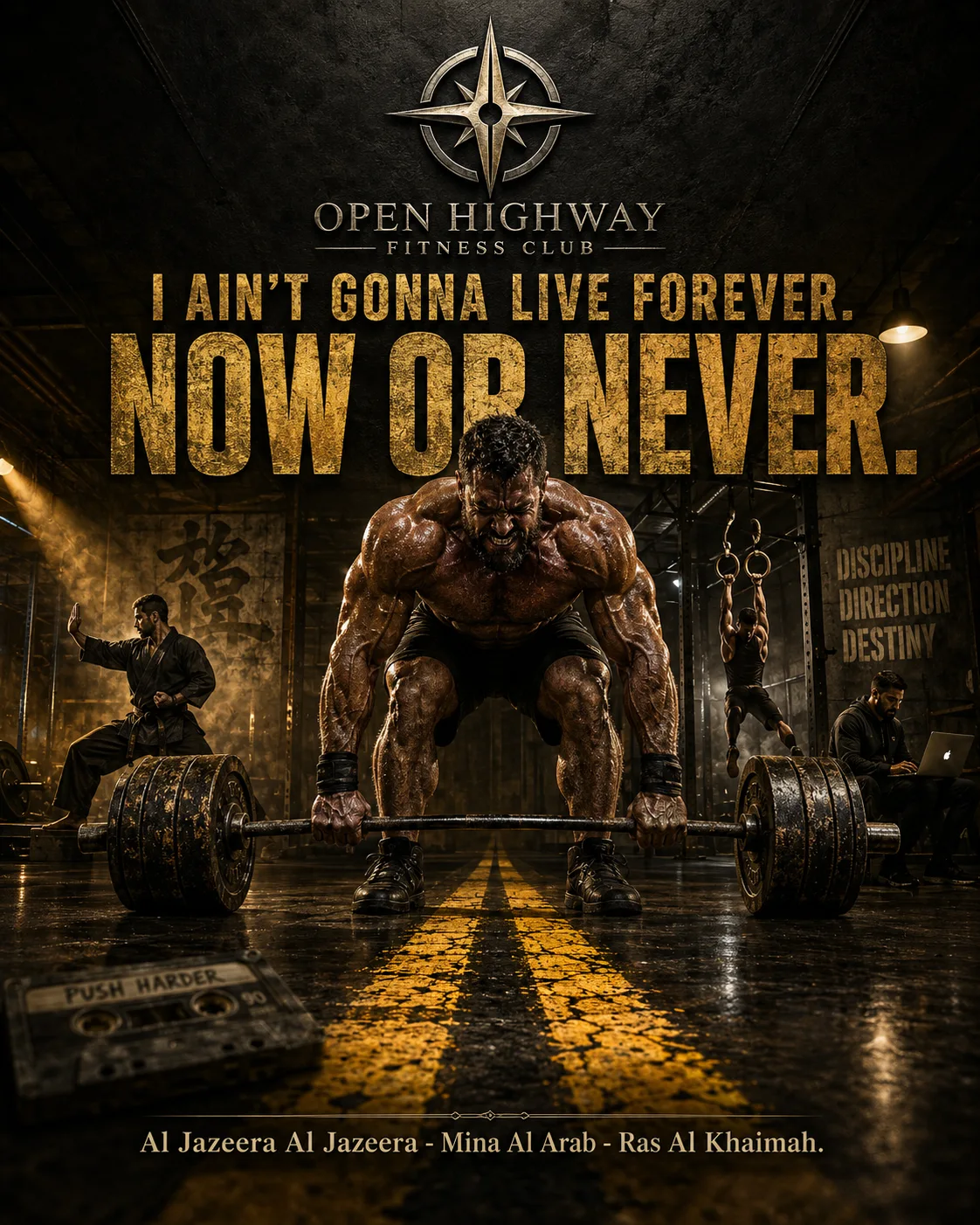
Why Did the First Output Require Human Correction?
The first output was strong but contained a critical error. Background figures included a martial arts practitioner and gymnastics rings, referencing the niche services listed on the original flyer. These are activities that do not exist in most gyms. By keeping them in the visual, the campaign subtly reverted to a feature list, just a more cinematic one.
This is where the human review step demonstrated its necessity. The correction was precise: remove the niche elements and replace them with the universal equipment found in every gym, including treadmills, stationary bikes, and free weights. The reasoning was not aesthetic. It was strategic. The campaign's message was about a state of mind, not about a specific facility's inventory. Universal equipment keeps the focus on the person, not the product.
This correction also reflects a core principle of the GEO and AEO visibility framework: the most effective content speaks to the broadest possible audience within its target segment. A campaign that excludes most gym-goers because they do not practice martial arts is a campaign that reaches a fraction of its potential audience.
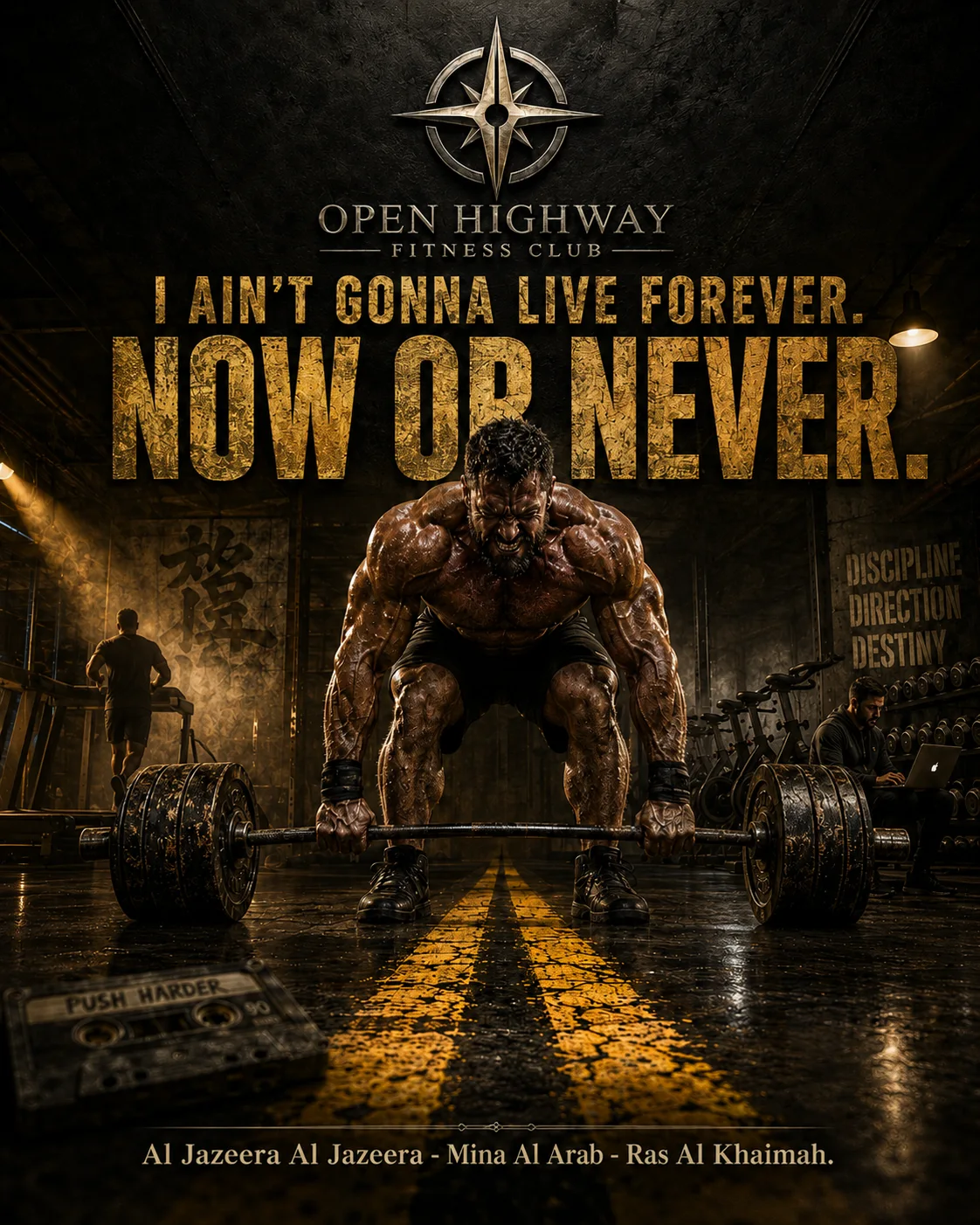
What the Final Campaign Actually Demonstrates
The final campaign is not remarkable because of the AI's rendering capability. It is remarkable because of the specific cognitive gap it creates. The cassette tape is an unusual object in a modern gym. A viewer scrolling past will stop, notice it, and mentally complete the connection. That moment of active participation is the difference between a campaign that is seen and a campaign that is remembered.
The feature list never appears. The cultural reference is never explained. The audience is trusted to complete the circuit themselves, and in doing so they form a much stronger cognitive imprint than any amount of explanatory copy could have produced. This is strategic silence from Step 4 in practice. For brands applying this approach to their fitness digital marketing strategy in the UAE, the principle applies across every format and every platform.
AI Is Not Here to Steal Your Job. It Is Here to Help You Do It Better.
The misuse of AI in marketing is not a technology failure. It is a thinking failure. The tools work exactly as intended. The problem is where practitioners have placed them in the workflow.
The anxiety about AI replacing creative professionals rests on a false premise: that AI is capable of originality. It is not. It is capable of extraordinary speed, comprehensive pattern recognition, and structural assembly at a scale no human team can match. But it cannot make the lateral jump. It cannot connect a gym brief to a specific song and produce a campaign that feels like it was written by someone who has actually lived.
When AI is placed at the beginning of the creative workflow and asked to generate the idea, the campaign is born on the bell curve. When AI is placed in the middle of the workflow and given two human-selected inputs to synthesize, the campaign is born at the intersection of two domains that would never naturally overlap. That intersection is where original work lives.
If people stop exercising their imagination, their strategic muscles atrophy. They lose the ability to find the obscure angles or inject the human friction that gives a campaign its soul. Originality is the only element that guarantees true traction, and you cannot automate the human edge out of the equation.
How Does This Apply to UAE Businesses Specifically?
The UAE market presents a particularly acute version of the sameness problem. The UAE National AI Strategy 2031, published by the UAE Government, positions the country as a global AI leader, yet most digital marketing practitioners in the region are using AI tools in ways that reduce rather than amplify their differentiation. Frameworks imported from western markets are applied without the cultural adaptation that makes campaigns resonate locally. The result is a saturated feed where even localized content shares the same structural DNA as its international templates.
Businesses in Ras Al Khaimah, Sharjah, and the emerging commercial zones of the UAE operate at the intersection of multiple cultural contexts: Gulf Arabic, South Asian, western expatriate, and Chinese commercial communities. Each community carries its own deep well of cultural artifacts that can serve as lateral jump anchors. That context is the one input no model trained on generic web data can replicate. The GEO and AEO approach used for UAE clients incorporates this cultural specificity directly into search and AI engine visibility strategy.
Three Additional Workflow Structures for Forcing AI Out of the Bell Curve
The Open Highway Framework is one approach. These three supplementary methods can be layered on top or used independently to produce the same effect in different campaign contexts.
The Dialectical Prompt Chain
Structure any AI-assisted creative session as a three-stage debate. First, ask the model for the most standard strategy for the brief. This is the thesis. Second, force the model to attack its own output and design a campaign that does the exact opposite using a completely foreign framework. This is the antithesis. Third, run a synthesis prompt that merges the strongest elements of both. The result is structurally sound but creatively unexpected.
Is Curated RAG Better Than Open AI Search?
Retrieval-Augmented Generation, or RAG, as defined by IBM Research, feeds a model a specific document set as its knowledge base rather than its general training data. The creative application builds two distinct clusters: one with technical product documentation, one with unrelated material such as literature or historical accounts. Forcing the model to query both simultaneously and find intersecting nodes produces non-obvious connections. This connects to the structured content architecture used in advanced ecommerce content strategy in the UAE.
Persona-Clash Ideation
Instead of a single expert persona, assign three contradictory personas and have them debate the brief simultaneously: a veteran technical marketing director, a skeptical younger consumer, and a behavioral psychologist. The friction between these viewpoints surfaces cultural references and emotional tensions that a single persona would never produce. The practitioner selects from the range rather than accepting one consensus output.
Frequently Asked Questions About AI and Human Creative Collaboration in Marketing
Ready to Build Campaigns That Actually Cut Through?
Titan Digital UAE works with businesses across Ras Al Khaimah, Dubai, and the UAE to build marketing strategies that are structurally sound and creatively original. If your campaigns are dissolving into the feed, we can fix that.
Message Us on WhatsApp
Kaan leads digital strategy at Titan Digital UAE, working with businesses across Dubai, Abu Dhabi, Ras Al Khaimah, and the Northern Emirates. He runs AI marketing workshops at Innovation City RAK and at the Istanbul Finance Institute, teaching practitioners to use AI as a creative lever rather than a creative replacement. Titan Digital has been operating across Canada, USA, Hong Kong, and the UAE since 2008.