Where strategy meets evolution.
Marketing philosophies have changed dramatically with the rise of digital platforms. While traditional marketing focused on mass communication and long-term brand building, digital marketing introduced precision, personalization, and real-time interaction.
Both worlds aim to connect brands with customers, but the way they think, measure, and adapt is vastly different. Let’s explore how modern marketing philosophies diverge across digital and traditional channels, and why mastering both can future-proof your B2C brand.
1. Customer-Centricity: One-Way vs. Real-Time Relationships
Traditional marketing was built on assumption-driven understanding; think surveys, focus groups, and generalized messages. It spoke to the audience, not with them.
Digital marketing flipped the script. Brands can now listen, learn, and respond instantly. Social media, chatbots, and email automation make it easy to tailor every interaction.
Example: A beauty brand can track customer preferences online, recommend matching products, and follow up with personalized tutorials, something a print ad simply can’t do.
In short:
Traditional = Broadcast.
Digital = Conversation.
2. Data-Driven Decisions: From Guesswork to Growth Loops
Traditional campaigns were like launching a rocket; once it’s in the air, you wait and hope it lands. Tracking success relied on ratings, sales lifts, or post-campaign reports.
Digital marketing is like piloting a drone; you see everything in real time and can adjust course instantly.
With analytics dashboards, brands can test multiple ad variations, compare ROI, and refine campaigns daily.
Example: An e-commerce brand can A/B test two ad headlines, track which gets higher conversions, and shift all budget toward the winner, all in one afternoon.
3. Content & Engagement: Static vs. Interactive
Traditional content (TV, radio, billboards) is static. It reaches many but speaks once.
Digital content breathes. It’s shareable, commentable, and alive. From TikTok challenges to Instagram polls, customers participate, not just observe.
Example: A café might run a “#MyMorningLatte” campaign encouraging customers to share photos of their drinks. In return, the brand gets organic exposure, a two-way win that would cost thousands in print advertising.
4. Personalization: One Size Fits None
Traditional marketing builds general awareness. It’s great for reaching everyone, but not for speaking to someone.
Digital marketing thrives on segmentation. Brands can target by demographics, behaviors, interests, or purchase intent, delivering the right message to the right person at the right moment.
Example: A fitness brand can send “Get Summer Ready” ads to users browsing workout gear, while showing “Stay Active Indoors” to colder-climate customers, all automatically.
5. Adaptability: Agility is the New Advantage
Traditional campaigns take weeks (or months) to produce and change. Once the magazine is printed or the billboard is up, it’s locked.
Digital marketing campaigns can pivot instantly. If an ad underperforms, pause it. If a trend emerges, join it.
Example: A home décor store can switch from promoting “Outdoor Furniture” to “Cozy Indoors” the moment the weather shifts and update all visuals in under an hour.
6. Summary Table: Digital vs. Traditional at a Glance
| Aspect | Digital Marketing | Traditional Marketing |
|---|---|---|
| Medium | Online platforms (web, apps, social media) | Offline (TV, print, radio, billboards) |
| Cost Efficiency | Scalable, measurable, low entry cost | High upfront investment |
| Targeting & Personalization | Precise, data-based segmentation | Broad, generalized messaging |
| Engagement | Interactive, two-way dialogue | One-way broadcast |
| Measurability | Real-time analytics and tracking | Limited or delayed reporting |
| Speed & Flexibility | Fast to launch and easy to adjust | Slow, rigid once deployed |
| Content Format | Dynamic multimedia | Static creative |
| Feedback Loop | Instant (comments, reviews, DMs) | Slow (surveys, phone feedback) |
7. Real-World Examples: Same Goal, Different Paths
Product Example: Sneaker Brand
A new sneaker company launches a collection:
- Digital approach: runs Instagram and TikTok ads targeting 18-35-year-olds who follow sports or streetwear influencers. Real-time feedback drives quick design and messaging tweaks.
- Traditional approach: a glossy print ad and a TV spot during major sports events to build broad awareness and credibility.
Result: Digital drives engagement and sales, while traditional builds long-term brand trust.
Service Example: Local Cleaning Business
- Digital: runs Google Ads targeting “home cleaning near me,” posts before-and-after photos on social media, and uses WhatsApp for quick booking.
- Traditional: distributes flyers and sponsors a segment on local radio.
Result: Traditional builds local familiarity; digital converts leads into customers.
8. The Big Picture: Integration Wins
It’s not about Digital vs. Traditional.
It’s about using both strategically.
Traditional channels give authority and reach; digital delivers relevance and real-time performance.
Modern B2C marketing thrives when both philosophies coexist; one builds the story, the other drives the action.
Titan Digital UAE: The Bridge Between Old and New
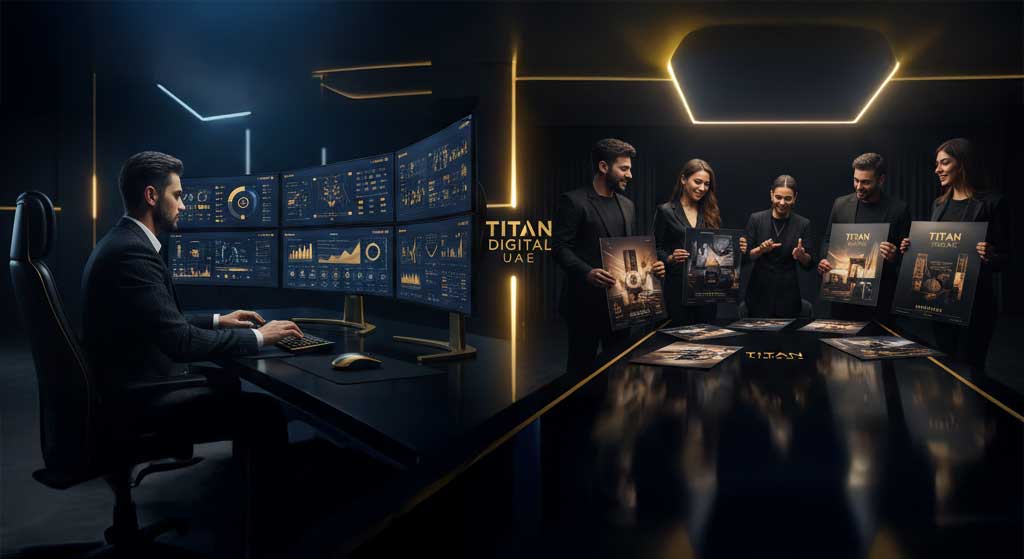
Running integrated campaigns takes time, tools, and expertise. Most businesses simply don’t have the hours to manage data, ad platforms, and creative all at once. That’s where we come in.
At Titan Digital UAE, we combine North American strategy with UAE market insight to help B2C brands connect with the right audiences across every channel, digital or traditional.
From paid social and SEO to billboard design and campaign analytics, we make your marketing smarter, faster, and measurable.
Work smarter, reach further, and grow faster with Titan Digital UAE.
titandigitaluae.com
You can read our complete breakdown of Digital Marketing vs Traditional Marketing here: https://titandigitaluae.com/digital-marketing-insights/digital-vs-traditional-marketing-how-b2c-marketing-philosophies-differ/