
David Learman: a hand-coded art photography website run from one CSV file
No database, no CMS, no checkout. Just the photographs, and a way to ask for them.
David Learman is an award-winning art photographer in Ras Al Khaimah, known for the Al Hejin camel racing collection. We hand-coded his site in English and Arabic, drove every gallery from a single CSV file, and built a print cart that ends in a conversation, not a payment.
Website, launch press release and social media by Titan Digital Marketing.
Titan Digital Marketing built davidlearman.com for David Learman, an award-winning art photographer in Ras Al Khaimah. The hand-coded site runs in English and Arabic, builds every gallery from a single CSV file, and replaces checkout with a print inquiry cart, so buyers select prints online and agree size and framing with David directly.
The David Learman case study shows what happens when a website follows the way an artist actually sells. David's prints hang in private collections across the UAE, and his buyers expect a conversation about size, edition and framing. The site had to show the work at its best, keep a large archive organised, and turn interest into that conversation.
Where we picked it up
David had a site concept that did not match the elegance of his work, and a large archive of images built up over decades of shooting.
David began his career in the early 1980s shooting haute couture on European runways. Today he photographs vanishing landscapes, people and heritage across the UAE. His best-known body of work, the Al Hejin collection, came from twice-weekly visits over four years to the Al Sawan camel racing track in Ras Al Khaimah. In 2023 he was one of 74 photographers invited to exhibit at the Xposure International Photography Festival in Sharjah, and in 2024 World Art Dubai named him Best Photographer.
An archive that size, spread across years of shoots, needed one reliable place for every title, year and location. And his buyers needed a way to choose prints online without a checkout that does not fit how fine art sells.
Why one CSV file runs the whole site
No database and no content management system. Every image on the site is one row in a spreadsheet.
Each row holds an image's title, year, location, collection and category. The site's code reads the file and builds the Signature and Exclusive galleries, the captions under each photograph and the options in the print cart. A shortened example:
For an artist, the archive is the business
Our read: a photographer's value sits in a body of work, and that body of work only sells if every piece has the right title, year and story attached. A spreadsheet is the one tool every artist already uses. By making it the site's single source of truth, we put the archive in a format David can open, check and extend himself, and the website rebuilds itself from it.
Skipping a database also means fewer moving parts: nothing to patch, nothing to back up separately, and pages that load only the code each gallery needs.
A shopping cart without a transaction
Visitors shop like they would anywhere else. The last step is a message to David, not a payment form.
A buyer browses the collections, adds the prints they want to a cart and sends the whole selection as a print inquiry. Every Signature print comes in fixed sizes, from 40 by 60 cm to 80 by 120 cm, with a border for framing, and David checks each print personally before dispatch. Exclusive prints exist in limited numbers only.
Fine art buyers want to discuss edition, size and framing before they commit, and a payment gateway would add fees and complexity for a sale David always closes in person. The cart keeps the familiar shopping experience and hands the final step to the artist.
Design built around the photographs
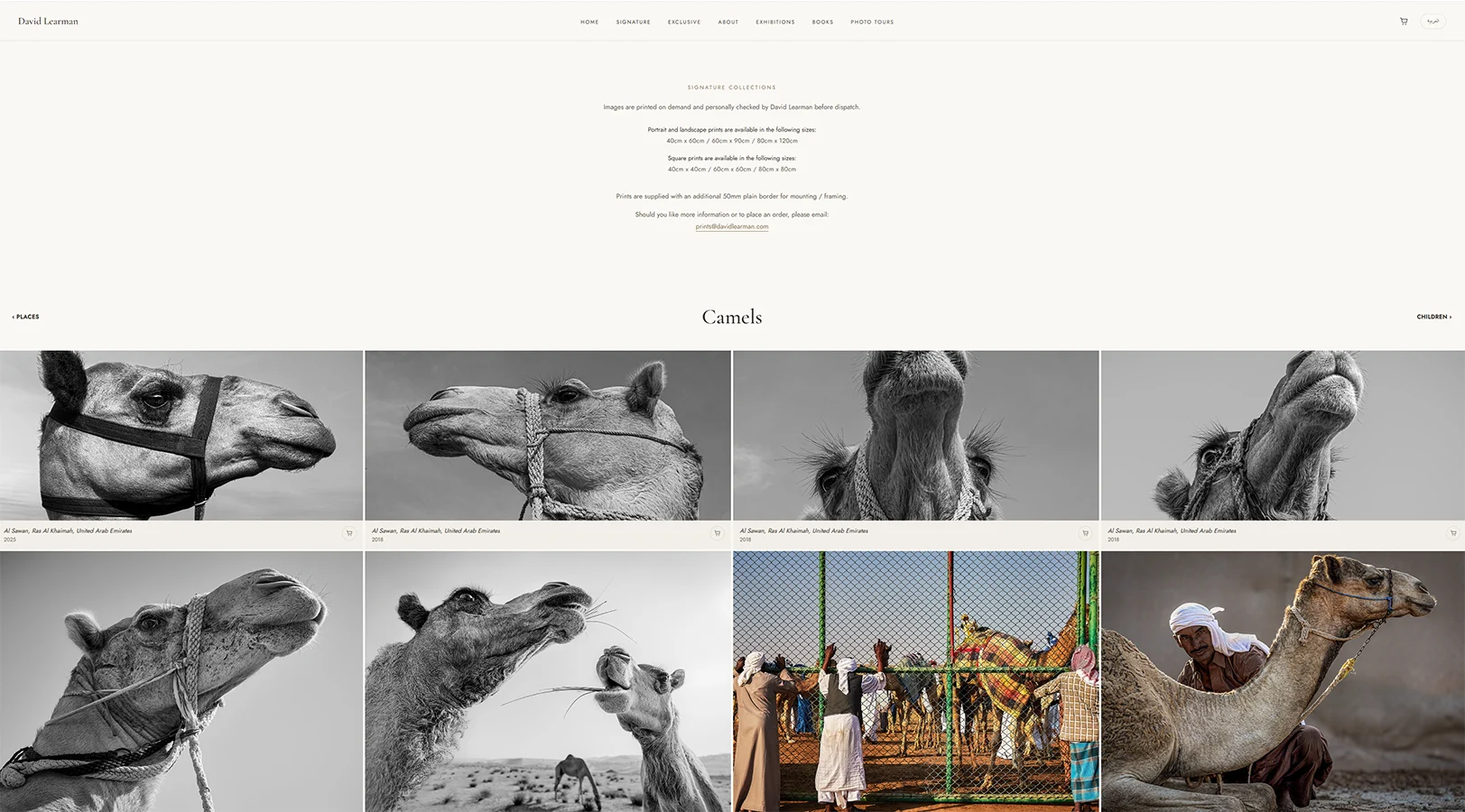
David's images are rich and full of colour. Every design decision steps back to let them lead.
Warm off-white and charcoal
A warm off-white background with charcoal text and a bronze accent, quieter than pure white and black, so the colour in each photograph stands out.
Two collections, two typefaces
Signature uses an italic serif and Exclusive an upright serif, so a visitor always knows which collection they are looking at.
A slow-zoom hero
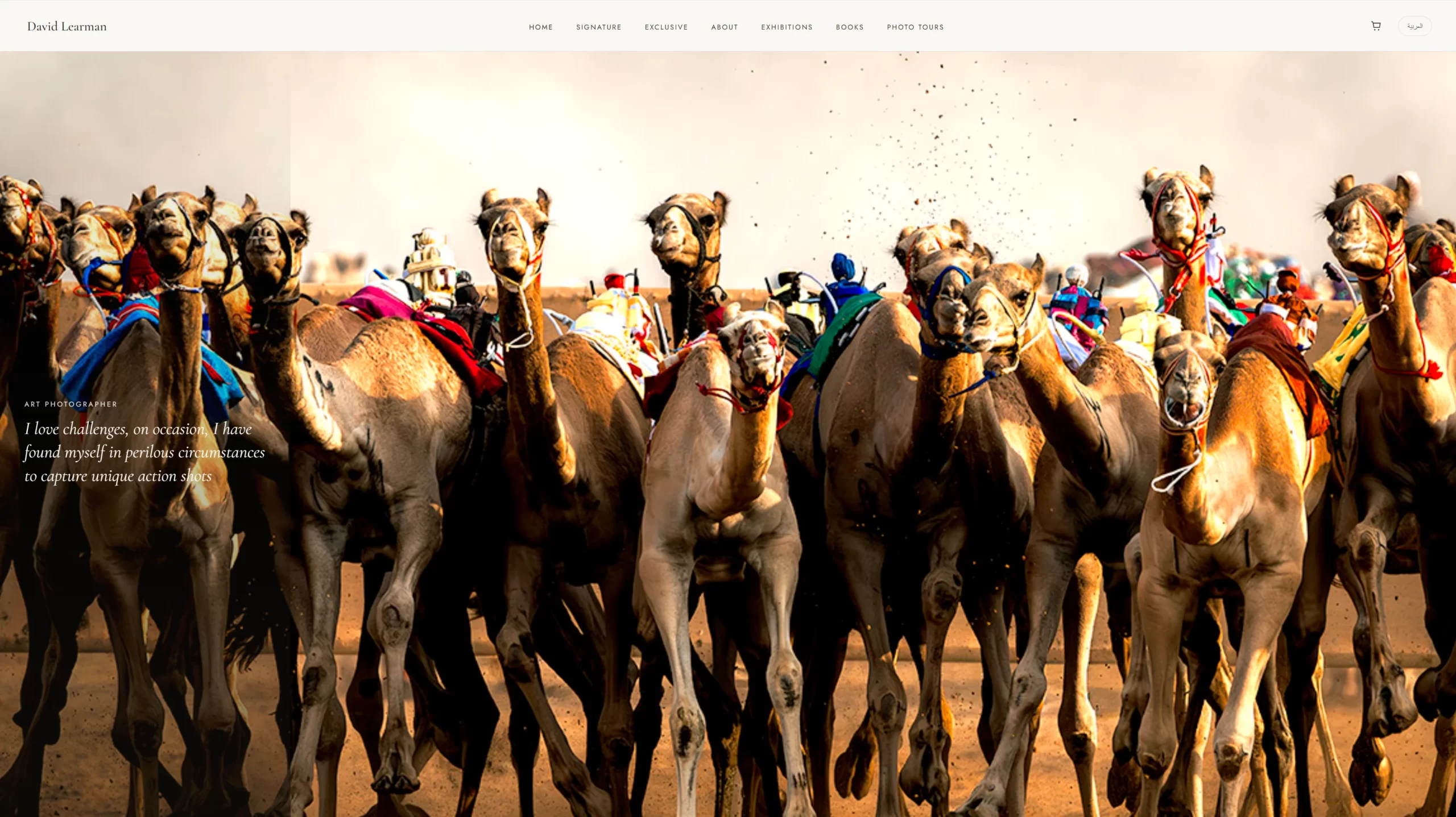
The homepage hero drifts slowly across a photograph with a gentle parallax caption, and the collection tiles below stay still so the work speaks first.
A portrait inside a camera
The about section masks David's black and white portrait into the silhouette of a camera, a single image that says who he is and what he does.
Where we ended up
David has a fast, elegant site that holds his whole archive and turns interest into print inquiries, plus a launch campaign to introduce it.
An archive he can manage himself
New prints, titles and years go into one CSV file, and the site updates from it.
Inquiries that arrive complete
Each print inquiry lists the exact prints a buyer selected, so David starts every conversation with the details in hand.
More than a gallery
Exhibitions, books and photo tours pages give buyers, curators and students reasons to return, in English and Arabic.
A launch, not just a site
We published his launch press release and ran his social media for the first 30 days with captions written for each post.
See another personal brand build in our Alana Annear case study, or read about our website design work in Ras Al Khaimah.
Questions about this project
What did Titan Digital Marketing build for David Learman?
Titan Digital Marketing built davidlearman.com, a hand-coded portfolio for David Learman, an award-winning art photographer based in Ras Al Khaimah. The site runs in English and Arabic, presents his Signature and Exclusive collections across five categories, and adds a print inquiry cart, exhibitions, books and photo tours pages. Titan also handled his launch press release and social media.
How does a website run from a CSV file?
Every image on davidlearman.com has one row in a CSV file: title, year, location, collection and category. The site reads that file and builds the galleries, captions and inquiry options from it. Adding a new print means adding one row, with no database and no content management system to maintain.
What is a shopping cart without transactions?
Visitors add prints to a cart on davidlearman.com the way they would in a shop, then send the whole selection to David as a print inquiry instead of paying online. Fine art buyers expect a personal conversation about size, edition and framing, so the cart collects the choice and David closes the sale himself.
Why not use WordPress or Shopify for an art photography portfolio?
A gallery of large images needs speed and full control of layout, and David sells by conversation, not checkout. A hand-coded site loads only what each page needs, puts no theme between the photographs and the viewer, and avoids paying for e-commerce features the business model never uses.
Your work deserves a site that gets out of its way
We build portfolio websites for photographers, painters and makers that sell the way artists actually sell. Tell us about your work.

Kaan leads strategy at Titan Digital Marketing, an agency he has run since 2008 across Canada, the USA, Hong Kong, and the UAE. He builds websites and launch campaigns for artists and personal brands in the UAE, from portfolio design to press and social media. He teaches AI strategy at Istanbul Finance Institute and runs regular AI and marketing workshops at Innovation City, Ras Al Khaimah.