
Michael Tyler: from accounting data to a bilingual wholesale fashion catalogue
One bulk import feeds the website, the French pages, the catalogues and the posters.
Michael Tyler Collections is a family-run Montreal clothing designer and wholesaler, in business since 1997. We built mtyler.ca from scratch, import their product data in bulk from their accounting system, rewrite every description for search in English and French, and produce the collection imagery, catalogues and posters their retailers sell from.
Website, product content, French pages, AI imagery and sales collateral by Titan Digital Marketing.
Titan Digital Marketing built mtyler.ca for Michael Tyler Collections, a Montreal women's clothing wholesaler founded in 1997. Product data comes in bulk from the company's accounting system, and Titan rewrites each description for search in English and French, then turns the same data into AI collection imagery, catalogues and posters for retailers.
The Michael Tyler case study covers a wholesale fashion brand whose real customer is the boutique owner, not the shopper. Every season brings hundreds of new styles, each with a fabric, a fabric content, a colour list and a size range. The work was to turn that data into pages buyers can find and trust, in both of Quebec's working languages, and into the sales material retailers use in store.
Where we picked it up
A family business with decades of styles, and product data that lived in an accounting system, not on a website.
Michael Tyler has designed comfortable, affordable contemporary clothing for women since 1997, often in fabrics sourced from Europe, according to the company's own history on mtyler.ca. The collection sells through retail partners: independent stores open a reseller account with the sales team and order each season.
Michael Tyler is a wholesaler, not a retailer, so the product records sat in the company's accounting system: a style name, a fabric, the fabric content, the colours and the size range. That data works for invoicing. It does nothing for a buyer searching for a pleated jersey dress, and nothing for a boutique owner deciding what to put in the window. We built the website from scratch, then built the process that keeps it full.
From accounting export to product page
One bulk import per season. Every row becomes an English page and a French page, each written for the people who search in that language.
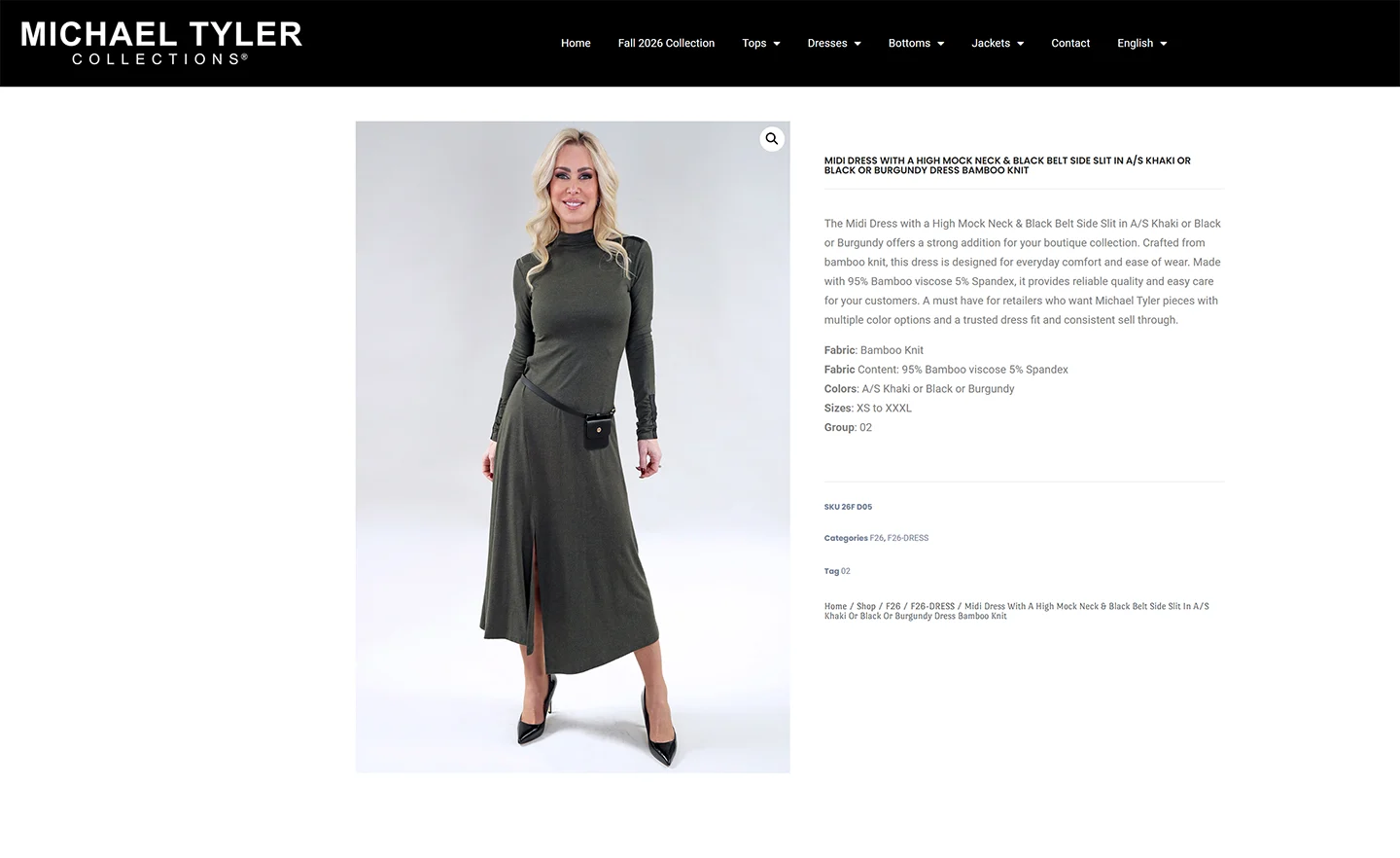
Each season, the new styles come out of the accounting system as a bulk export and go into WooCommerce in one import. The structured fields carry over as they are, so fabric, content, colours and sizes always match the company's records. Then we rewrite the description for every product. Here is one style, the Izo long dress, at each stage:
Izo | Dress | Pleated Jersey | 100% Polyester | Black, Plum | 2 to 16
Simplified, illustrative row
"The Long Dress in Black or Plum offers a strong addition for your boutique collection. Crafted from pleated jersey..." Written for the retail buyer, with the specs listed below.
"Robe longue, Plissé Jersey, Noir ou Prune." Written in French for French search, with its own title, slug and description, not a word-for-word translation.
The English and French pages talk to different readers
Our read: the English pages speak to the boutique owner, in the language of sell-through, colour options and a dependable fit. The French pages lead with the woman who will wear the piece. Same product, same specs, two different jobs.
Keeping the structured fields untouched matters just as much. A retailer reading "Sizes: 2 to 16" on the site has to see exactly what the order form says. Accurate specs come from the source data, and we only write the copy around them.
A wholesale catalogue with no checkout
WooCommerce handles the products and categories. The cart and the prices stay switched off.
mtyler.ca runs on WordPress with WooCommerce in catalogue mode: every style has a full product page, but nobody can buy online and no prices show. Wholesale pricing belongs in the reseller relationship, so the site's job is to show the range and send interested stores to the sales department.
Each season gets its own category tree. Fall Winter 2026 splits into tops, dresses, bottoms and jackets, then into cardigans, tunics, camisoles, pants, leggings, coats, ponchos and more, so a buyer can go straight to the pieces they stock. The homepage then tells the season as stories rather than a grid, with edits such as Tailored Dark, Leopard After Dark and The City Coat Story, each written for a buyer planning a storefront.
We took the same approach for an agricultural exporter in our Ethiopia Export case study, a B2B WooCommerce catalogue that ends in a quote request instead of a payment.
Imagery, catalogues and posters for retailers
The data that builds the website also builds what retailers hold in their hands, and AI turns one model fitting into a full season of campaign imagery.
AI-generated collection scenes
We start from photos of Michael Tyler's own live model wearing each piece, then use AI to change her complexion, hair colour and facial features and to build a magazine-style setting, such as an autumn city walk in plaid and boots.
PDF and printed catalogues
Each season's styles go into a catalogue that the sales team emails to retailers as a PDF and prints for buyers who prefer paper.
Posters for the shop floor
Retailers display collection posters in their own boutiques, so the Michael Tyler look carries from the website into the store.
Visuals retailers can post
Retailers receive ready-made visuals to post on their own social media channels when the new season lands.
The clothes are real. The woman and the setting are not.
Our read: AI fashion imagery fails when the garment itself is invented, because a retailer orders what the picture shows. So we never generate the clothing. Every image starts from Michael Tyler's live model wearing the actual piece, which keeps the fit, the drape and the fabric true to what arrives in the box.
AI then changes only what does not affect the order: the model's complexion, hair colour and facial features, and the scene behind her. One fitting session becomes a range of women and a magazine look for every collection story, without booking a cast and a location each season.

Where we ended up
One source of product data now feeds a bilingual website and a full set of retailer materials every season.
A season goes live in one import
New styles move from the accounting system to the site in bulk, with no product entered by hand.
Every product written twice
679 English product pages, each matched by a French page written for French search.
Specs that match the order form
Fabric, content, colours and sizes come straight from the company's records, so the site and the sales team never disagree.
Retailers equipped to sell
PDF and printed catalogues, in-store posters and social visuals give partner stores the material to move the collection.
For another Montreal fashion and retail build, read our Roger Roy case study, or see our website design work in Ras Al Khaimah.
Questions about this project
What did Titan Digital Marketing build for Michael Tyler Collections?
Titan Digital Marketing built mtyler.ca from scratch for Michael Tyler Collections, a family-run Montreal women's clothing wholesaler founded in 1997. Titan imports each season's styles in bulk from the company's accounting system, rewrites every product description for search in English and French, and creates AI collection imagery, catalogues, posters and social visuals for retailers.
How does accounting data become a product page?
Each season, Michael Tyler's new styles leave the accounting system as one bulk export and enter WooCommerce in a single import. Fabric, fabric content, colours and sizes carry over unchanged, so the site always matches the company's records. Titan then writes a new description for every product, one in English and one in French.
Why does the Michael Tyler website show no prices or checkout?
Michael Tyler sells wholesale through retail partners, and wholesale pricing belongs inside the reseller relationship. The site runs WooCommerce in catalogue mode, so every style has a full product page with specs and photos, but no price and no cart. Stores that want to carry the collection open a reseller account with the sales team.
Are the French product pages translated from English?
No. Each French page on mtyler.ca has its own title, URL and description written in French, rather than a word-for-word translation of the English page. The English copy speaks to the boutique owner about sell-through and colour options, while the French copy leads with the woman who will wear the piece.
How does Titan create AI fashion imagery for Michael Tyler?
Titan starts from photos of Michael Tyler's own live model wearing each real garment, so fit, drape and fabric stay accurate. AI then changes the model's complexion, hair colour and facial features and generates a magazine-style background. The clothing itself is never generated, so retailers see exactly what they order.
What sales materials do Michael Tyler's retailers receive?
Each season, retailers receive PDF catalogues by email, printed catalogues, posters for their shop floor and ready-made visuals for their own social media. Titan builds all of them from the same product data and collection imagery as the website, so every channel shows the same styles, colours and sizes.
Your product data can sell for you
We turn wholesale and manufacturer product data into bilingual catalogue websites, catalogues and retailer materials. Tell us what your range looks like.

Kaan leads strategy at Titan Digital Marketing, an agency he has run since 2008 across Canada, the USA, Hong Kong, and the UAE. He builds catalogue websites and product content for wholesalers and manufacturers, from bulk data imports to bilingual SEO and print collateral. He teaches AI strategy at Istanbul Finance Institute and runs regular AI and marketing workshops at Innovation City, Ras Al Khaimah.