
How to Start a SaaS Business in the UAE


The UAE has quietly become one of the world's most SaaS-friendly jurisdictions: zero personal income tax, growing B2B demand across finance, logistics, and retail, and a free zone ecosystem purpose-built for remote-first software companies.
Unlike a retail business or a brick-and-mortar service, a SaaS company in the UAE does not need a physical storefront, a warehouse, or a local sales team on day one. The business model is subscription-based, often serving clients in GCC, Europe, or North America, while the legal entity sits in a cost-effective UAE free zone. That combination - low overhead, full foreign ownership, and regional credibility - is why founders from Canada to India are structuring their software companies here. The challenge is navigating the licensing options, getting a bank account that actually accepts SaaS transactions, and connecting a payment gateway that handles recurring billing correctly.
Table of Contents
Step 1: Define Your SaaS Model & Jurisdiction
Before comparing free zones, you need to classify your SaaS product. UAE licensing treats "software development," "IT consultancy," "digital platform," and "fintech SaaS" as distinct activity categories, and the wrong choice creates friction down the line with banks and regulators.
| SaaS Type | License Activity Wording | Special Approval Needed? |
|---|---|---|
| General B2B SaaS (CRM, ERP, HR tools) | Software Development / IT Services / Digital Platform | No. Standard free zone license. |
| Fintech SaaS (payments, lending, robo-advisory) | Financial Technology / Digital Financial Services | Yes. DFSA (DIFC) or FSRA (ADGM) sandbox approval required. |
| Web3 / AI / Blockchain SaaS | Digital Assets / Blockchain Technology / AI Platform | Recommended: RAK DAO or ADGM for regulatory clarity. |
| HealthTech SaaS | Healthcare IT / Digital Health Platform | May need Ministry of Health NOC depending on data handling scope. |
Quick Decision Tree: Free Zone vs. Mainland
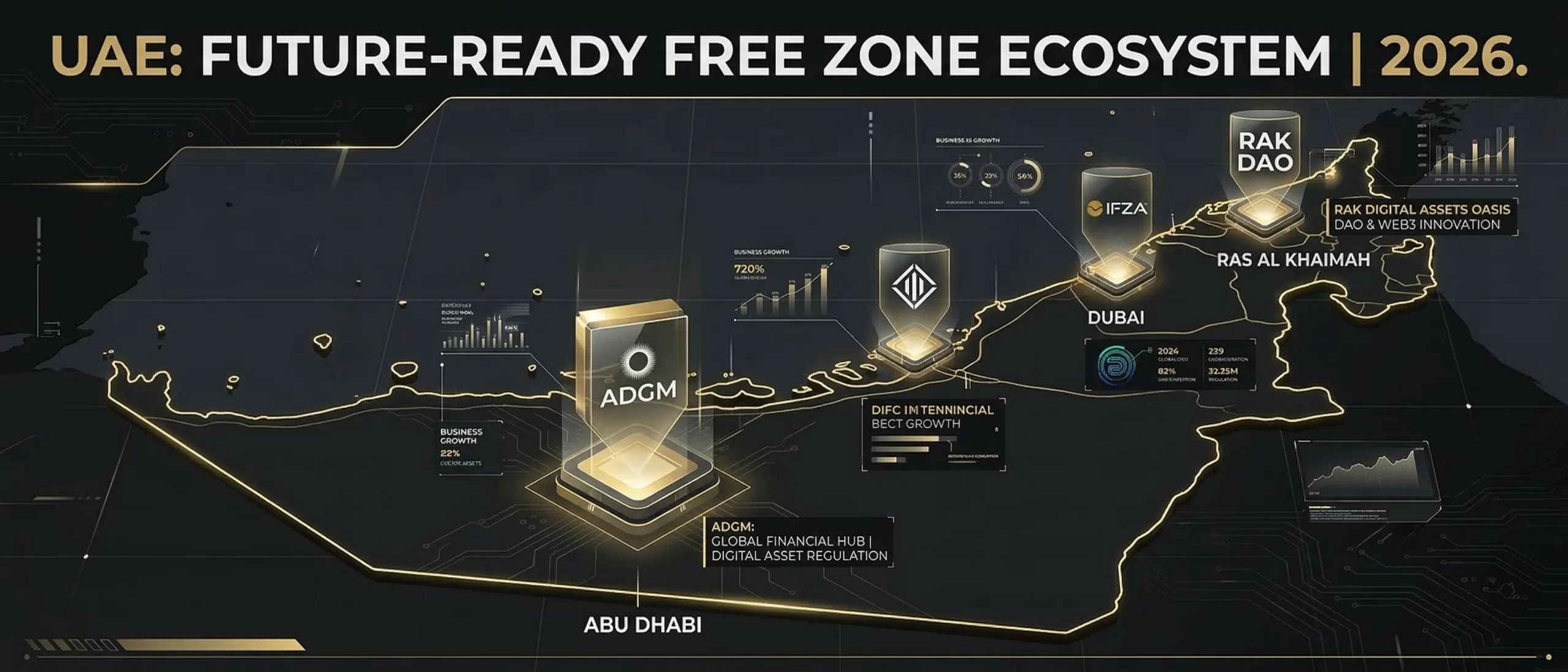
Step 2: Best Free Zones for SaaS in the UAE (2026)
Not all free zones are created equal for software companies. The right zone depends on your SaaS category, target market, budget, and whether you need regulatory credibility with banks and investors.
RAK Digital Assets Oasis (Innovation City)
RAK DAO is the UAE's dedicated tech free zone for Web3, digital assets, AI, metaverse, and blockchain-based SaaS platforms. It offers fast-track licensing, some of the lowest setup costs among UAE tech zones, and a growing startup community in Ras Al Khaimah. For founders building AI-native or Web3 SaaS products, RAK DAO provides regulatory clarity that general free zones cannot. It is also the natural home base for companies already operating from RAK.
IFZA (International Free Zone Authority)
IFZA is one of the most popular choices for bootstrapped SaaS founders. It offers multi-activity licenses (you can bundle "Software Development" + "IT Consultancy" + "Digital Platform" into a single license), strong banking acceptance, and a streamlined online application process. First-year setup costs frequently come in under AED 20,000 for a single-person company with a flexi-desk arrangement.
DIFC (Dubai International Financial Centre)
For fintech SaaS specifically, DIFC is the gold standard. Its DFSA Innovation Testing License gives regulated fintech startups a controlled sandbox to test payment, lending, and advisory platforms with real customers before obtaining a full license. DIFC also carries enormous credibility with UAE banks, VCs, and institutional investors. The trade-off is cost: setup typically starts from AED 80,000 and rises significantly with office and visa requirements.
ADGM (Abu Dhabi Global Market)
ADGM's FSRA RegLab sandbox is DIFC's closest competitor for emerging fintech, digital asset, and DeFi SaaS. It is often cited as more collaborative with startups and slightly lower in cost than DIFC. The RegLab sandbox approval fee is approximately USD 1,500, with full annual licensing around USD 15,000. Best suited for SaaS targeting GCC institutions or Abu Dhabi government-linked capital.
Meydan Free Zone & Dubai Internet City
Meydan offers cost-effective multi-activity licenses for general SaaS and IT businesses, with good banking relationships. Dubai Internet City carries prestige and proximity to tech enterprise clients in Dubai, but at a premium price. Both are viable for B2B SaaS companies targeting the Dubai market specifically. For remote-first or global SaaS, IFZA or RAKEZ typically offer better value.
| Free Zone | Best For | Est. Year 1 Cost | Banking Ease |
|---|---|---|---|
| RAK DAO | Web3, AI, blockchain SaaS | AED 15,000 - 30,000 | Good (RAKBANK, Wio partners) |
| IFZA | General B2B SaaS, bootstrapped | AED 18,000 - 28,000 | Strong |
| RAKEZ | Cost-conscious, RAK-based founders | AED 12,000 - 22,000 | Good (RAKBANK preferred partner) |
| Meydan FZ | Dubai-facing B2B SaaS | AED 20,000 - 35,000 | Strong |
| DIFC | Regulated fintech SaaS | AED 80,000+ | Excellent (banks actively seek DIFC) |
| ADGM | Fintech, DeFi, institutional SaaS | USD 15,000 - 30,000 | Excellent |
Step 3: Step-by-Step Licensing Process
Most UAE free zone SaaS licenses follow the same core process. Timelines range from a few days on fast-track applications to 8 weeks for complex, multi-activity, or regulated setups.
1. Define Your Business Activities
Choose activity codes that align with "SaaS / platform" language wherever possible. Common combinations for general SaaS: Software Development + IT Consultancy + Online Platform Services. Avoid activity codes that reference "trading," "brokerage," or "financial services" unless you are operating in those specific regulated areas, as they trigger additional approvals and increase banking scrutiny.
2. Reserve Your Trade Name
Submit 2-3 name options ranked by preference. UAE name rules prohibit offensive, religious, or politically sensitive terms. Avoid names resembling established brands (Apple, Microsoft, etc.). Most free zones allow entirely online name reservation within 1-2 business days.
3. Submit Your Application
Documents required: passport copy (all shareholders and directors), proof of address (utility bill or bank statement), a short business plan or activity description, and in some cases a No Objection Certificate (NOC) if you are currently employed on a UAE visa. For regulated SaaS (fintech/healthtech), a more detailed business plan outlining your compliance approach is usually required.
4. Receive License and Lease
Once approved, you receive your trade license and a flexi-desk or virtual office arrangement. The flexi-desk provides a physical legal address, which is required for banking and visa applications. A standard flexi-desk typically supports 1-3 visas and costs AED 5,000-15,000 per year depending on the zone.
5. Open Corporate Bank Account
Banking is the step that trips up most first-time UAE founders. See Step 5 below for a dedicated breakdown of the right banks for SaaS companies and the documentation required to pass onboarding.
6. Visas and Residency
Free zone license packages typically include 1-4 investor visas depending on your office arrangement. Each visa requires in-person medical testing and biometrics in the UAE, but the paperwork and initial application can be submitted remotely. A standard UAE residency visa for a free zone investor is valid for 2-3 years and is renewable.
Can I Set Up Remotely?
Yes. Most free zone applications - including RAK DAO, IFZA, RAKEZ, and Meydan - can be submitted and processed entirely online. You only need to physically visit the UAE to complete medical testing and biometric enrollment for your residency visa. The license itself does not require your physical presence during issuance.
Step 4: Costs & Setup Timeline
Below are realistic Year 1 cost estimates for a typical single-founder or small-team SaaS setup in a non-regulated UAE free zone. These figures cover licensing, a flexi-desk, and 1-2 visas. They do not include marketing budget, product development costs, or software infrastructure.
| Scenario | Zone | Estimated Year 1 Total | Timeline |
|---|---|---|---|
| Solo founder, bootstrapped | RAKEZ or IFZA | AED 18,000 - 28,000 | 7-14 days (license only) |
| Small team (2-3 people) | IFZA or Meydan | AED 30,000 - 50,000 | 2-4 weeks |
| Web3 / AI SaaS founder | RAK DAO | AED 20,000 - 40,000 | 1-3 weeks |
| Fintech SaaS (regulated) | DIFC or ADGM | AED 80,000 - 200,000+ | 6-16 weeks (sandbox process) |

Step 5: Banking for UAE SaaS Founders
Banking is the most commonly underestimated friction point for UAE SaaS founders. Traditional banks (Emirates NBD, ADCB, FAB) often require 6-12 months of trading history before opening a business account for a newly incorporated entity. The good news: the digital banking landscape has changed dramatically.
Making Your Company "Bankable"
Banks care about risk clarity more than your tech stack. Before approaching any bank, prepare: a clean activity description (software development, IT services, digital platform - not crypto, FX, or investment unless licensed), a 1-2 page business overview describing your model, target markets, pricing, and expected transaction volumes, plus full KYC documentation (license, Memorandum of Association, lease agreement, passport copies, Emirates IDs, and source-of-funds letter for founders).
Free Zone Banking Partner Advantage
RAKEZ, RAK DAO, and IFZA all maintain formal banking partner relationships with specific institutions. When you apply for a bank account through your free zone's preferred partner (rather than cold-approaching a bank branch), approval rates improve significantly. Your free zone business development team can make formal introductions - always use this route first.
| Bank / Fintech | Best For | Onboarding Speed | Min. Balance |
|---|---|---|---|
| Wio Business | Early-stage SaaS, remote founders, multi-currency billing | 5-10 days (app-driven) | None |
| Mashreq NeoBiz | SMEs needing fast digital onboarding + API integrations | 7-14 days | Low |
| RAKBANK RakStarter | RAK-based free zone companies (RAKEZ/RAK DAO) | 7-14 days | Low |
| Emirates NBD Business | Established SaaS (12+ months trading), multi-currency | 4-8 weeks | AED 50,000+ |
| ADCB SME | Growing SaaS with UAE enterprise clients | 2-6 weeks | AED 25,000 |
For most new SaaS entities, the recommended path is: Wio Business or Mashreq NeoBiz for immediate launch (low-friction, digital-first), then upgrade to a traditional bank like Emirates NBD once you have 12 months of clean statements. This two-stage approach avoids the frustrating delays that kill momentum in the early months.
Step 6: Payment Gateways & Recurring Billing
For a SaaS business, recurring billing is non-negotiable. You need a payment gateway that handles subscription logic natively - automated renewals, failed payment retries, trial-to-paid conversion, and chargeback management. Many UAE gateways advertise "recurring payments" but only a few handle true subscription lifecycle management.
Telr / TotalPay
Telr (operating as TotalPay) explicitly supports recurring billing and subscription models, making it one of the top recommendations for UAE SaaS companies. It supports instalments, auto-renewals, and is well-integrated with common e-commerce and SaaS billing platforms. Apply with a complete website, Terms of Service, Privacy Policy, and a pricing page that clearly shows your subscription plans and refund policy.
noon Payments
noon Payments has a dedicated subscriptions product aimed at OTT, digital services, and SaaS platforms. It handles recurring payment plans and automated collection, with strong regional brand recognition. Their onboarding process for SaaS specifically asks for subscription terms, chargeback policy documentation, and KYC of your end-customers if you are selling into high-risk geographies.
Other Options
PayTabs, Stripe (via UAE entity), and HyperPay also support recurring billing and multi-currency invoicing. For B2B SaaS with longer billing cycles (annual or quarterly), many UAE founders also use automated invoice workflows (via Zoho, QuickBooks, or Xero) combined with a standard bank transfer arrangement, bypassing gateway fees entirely on high-value contracts.
Gateway Application Checklist
Before submitting your gateway application, confirm you have:
- A live website with clear subscription pricing and plan descriptions
- A published Terms of Service and Privacy Policy (required by every gateway)
- A clear refund and chargeback policy for subscription cancellations
- An active UAE corporate bank account with an IBAN
- Your trade license, MoA, and Emirates ID (for the gateway's own KYC)
Step 7: Tax, VAT & Compliance
The UAE introduced a federal corporate tax in June 2023. Understanding how it applies to your SaaS entity is important from day one - not as a burden, but as a planning advantage.
Corporate Tax (9%)
UAE federal corporate tax is 9% on taxable income exceeding AED 375,000. Free zone entities can qualify for a 0% rate on "qualifying income" - broadly, income derived from transactions with other free zone persons or from specific approved activities. If your SaaS company bills clients outside the UAE, most of that revenue will likely qualify under the free zone regime. However, the exact rules are nuanced and depend on your specific activities and customer base. Consult a UAE-registered tax advisor before your first invoice.
VAT (5%)
UAE VAT registration is mandatory once your annual taxable supplies exceed AED 375,000. Voluntary registration is possible from AED 187,500. For SaaS companies billing UAE-based clients, VAT applies at 5% to your subscription fees. For clients outside the UAE (GCC excluded), exports of services are generally zero-rated - but the rules on place-of-supply for digital services are specific. Ensure your billing platform can handle VAT calculation and invoicing correctly from the start.
UAE PDPL (Data Protection)
The UAE Personal Data Protection Law applies to any SaaS product processing the personal data of UAE residents. Key obligations include maintaining a data processing register, a 72-hour breach notification procedure, and potentially appointing a Data Protection Officer for large-scale data processing. Building PDPL-compliant data handling into your product architecture from the outset is both a legal requirement and a credible enterprise sales argument.
Regulated Activity Warning
If your SaaS product touches payment processing, lending, investment advice, or insurance - even peripherally - do not assume a standard "software development" license is sufficient. Operating regulated financial activities without the correct DFSA or FSRA license is a serious compliance breach in the UAE. Use the DIFC or ADGM sandbox pathways before going live with any regulated feature set.

Step 8: Go-to-Market Strategy for UAE SaaS
Getting your license and banking sorted is the foundation. The ceiling of your business is determined by your go-to-market architecture. SaaS sales cycles in the GCC vary widely - a mid-market B2B deal in the UAE can close in 2-6 weeks, while an enterprise contract with a government-linked entity can take 6-12 months.
Build Your Digital Trust Stack First
UAE enterprise buyers will audit your digital presence before accepting a demo request. Your website, LinkedIn company page, and local SEO footprint must all tell the same credible story: who you serve, what results you deliver, and why your team has the credibility to deliver them. A newly incorporated SaaS company with no case studies, no thought leadership, and a one-page website does not win enterprise deals in the UAE.
| Channel | Best Use Case | Budget Split (Suggested) | Lead Timeline |
|---|---|---|---|
| LinkedIn ABM | Reaching UAE/GCC decision-makers in target verticals (finance, logistics, retail) | 35% | 1-3 months |
| SEO / AEO Content | Capturing high-intent "SaaS for [industry] UAE" searches and AI answer engine citations | 25% | 3-6 months |
| Google Search Ads | Targeting in-market buyers searching for software solutions in specific industries | 20% | Immediate |
| Email & Demo Nurture | Converting free trial users and inbound leads to paying subscribers | 15% | Ongoing |
| Events & Co-working | RAK Entrepreneurs events, GITEX, Dubai Tech meetups for warm referrals | 5% | Variable |
The "Vertical Authority" SaaS Strategy
The fastest way to scale a SaaS business from a UAE base is to own a vertical, not compete broadly. Instead of positioning as "project management software," position as "the project management platform built for UAE construction contractors." Write 6-8 deep content pieces on your target industry's specific pain points, build case studies named by sector (not by client if confidential), and invest in UAE-specific SEO for industry-specific queries. Vertical authority is how bootstrapped SaaS companies in the UAE outmaneuver better-funded generic competitors. Titan's content marketing services and SEO team specialize in building exactly this kind of authority architecture for B2B SaaS clients.
For founders based in the Northern Emirates, the RAK startup ecosystem is also underutilized as a go-to-market channel. RAK Entrepreneurs workshops, RAK Chamber of Commerce events, and the Innovation City community provide warm, high-quality referral networks that most Dubai-centric SaaS companies overlook. See our Ras Al Khaimah digital marketing hub for a full breakdown of the local business development landscape.
About the Author: Kaan Bozoglu
Kaan is the Managing Director of Titan Digital Marketing UAE. With over 25 years of international marketing and digital strategy experience, he works with SaaS founders, tech startups, and B2B companies to build the digital architecture they need to acquire enterprise clients across the GCC and beyond.
Ready to Launch Your SaaS Business in the UAE?
Your license can be issued in 7 days. Winning your first UAE enterprise client takes a credible digital presence, the right content architecture, and a channel strategy that fits your sales cycle. Tell us about your SaaS product, and our team will outline the exact go-to-market blueprint for your sector.
UAE SaaS Business FAQs
Do I need a special SaaS license in the UAE?
There is no "SaaS-only" license category in the UAE. A SaaS business is licensed under software development, IT services, or digital platform activities - standard professional license categories available at most free zones. The exception is fintech SaaS, which requires regulatory approval from DFSA (DIFC) or FSRA (ADGM).
What is the cheapest free zone to set up a SaaS company in the UAE?
RAKEZ and RAK DAO consistently offer some of the lowest first-year setup costs for tech and software companies, often in the AED 12,000-25,000 range including a flexi-desk. IFZA is also competitive for multi-activity SaaS licenses and has excellent banking partner relationships.
Can I set up a UAE SaaS company without visiting the UAE?
Yes. The full incorporation process for most UAE free zones can be completed online. You only need to physically visit to complete your residency visa medical test and biometric enrollment. The license and corporate bank account can be arranged remotely in most cases.
Which payment gateway is best for SaaS subscriptions in the UAE?
Telr (TotalPay) and noon Payments are the two recommended gateways for true subscription lifecycle management in the UAE. Both support recurring billing, automated renewals, and failed payment handling. Stripe is also available for UAE entities but requires separate setup. Ensure your website has clear Terms of Service and a published refund policy before applying to any gateway.
Is it hard to get a UAE bank account for a SaaS company?
Traditional banks can be challenging for new entities. The recommended approach for SaaS startups is to open with a digital-first bank (Wio Business or Mashreq NeoBiz) for fast approval (5-14 days), then migrate to a traditional bank once you have 12 months of clean transaction history. Using your free zone's banking partner introduction channel also significantly improves approval rates.
Does UAE corporate tax apply to my SaaS business?
UAE corporate tax (9%) applies to taxable income above AED 375,000. Free zone entities can qualify for a 0% rate on qualifying income from international clients and free zone transactions. Income from UAE mainland clients may be taxable at 9%. Consult a UAE-registered tax advisor to structure your revenue recognition correctly from the start.
What is RAK DAO and is it good for SaaS companies?
RAK Digital Assets Oasis (RAK DAO) is a UAE free zone in Ras Al Khaimah purpose-built for Web3, digital assets, AI, metaverse, and blockchain companies. It offers fast licensing, lower costs than Dubai tech zones, and good banking partnerships. For AI-native or blockchain-based SaaS, it is one of the strongest options in the UAE.
Do I need to charge VAT on my SaaS subscriptions?
VAT registration is required once your annual taxable supplies exceed AED 375,000. If your SaaS clients are UAE-based, you charge 5% VAT. Services exported to clients outside the UAE are generally zero-rated for VAT purposes. Digital-service place-of-supply rules apply, so ensure your billing system handles UAE VAT correctly from the first invoice.
Can a free zone SaaS company sell to UAE mainland clients?
Yes. Free zone companies can supply services (including SaaS subscriptions) to UAE mainland clients. The income from those transactions may be subject to corporate tax at 9% rather than the 0% qualifying rate. Post-2023 UAE corporate tax legislation defines this distinction clearly - verify your specific situation with a tax advisor.
What is the difference between DIFC and ADGM for fintech SaaS?
Both offer dedicated regulatory sandboxes for fintech SaaS. DIFC is stronger for international investor credibility and banking relationships, with a larger established fintech ecosystem. ADGM's RegLab sandbox is generally more accessible for early-stage fintech startups and is better positioned for digital assets, DeFi, and Abu Dhabi institutional capital. ADGM sandbox approval fees are also lower than DIFC.
How can Titan Digital Marketing help my SaaS company in the UAE?
Titan provides end-to-end digital architecture for SaaS companies: SEO and AEO content strategy to capture high-intent SaaS searches, LinkedIn ABM campaigns targeting UAE/GCC decision-makers, website design and conversion optimization for SaaS buyer journeys, and email marketing for trial-to-paid conversion sequences. We work specifically with B2B SaaS companies scaling across the GCC.
Explore Other Business Blueprints
The Master UAE Guide
Return to the core guide covering all corporate tax, VAT, free zone regulations, and visa options.
IT & Cybersecurity Consulting
The blueprint for MSPs, cloud architects, and cybersecurity consultancies - NESA compliance, B2B lead gen, and the Tech Golden Visa.
Fashion E-Commerce
Logistics of dropshipping vs. warehousing, and high-converting Instagram strategies for UAE apparel brands.
RAK Digital Marketing Hub
B2B marketing, SEO, and lead generation strategies specifically for businesses scaling from Ras Al Khaimah.